


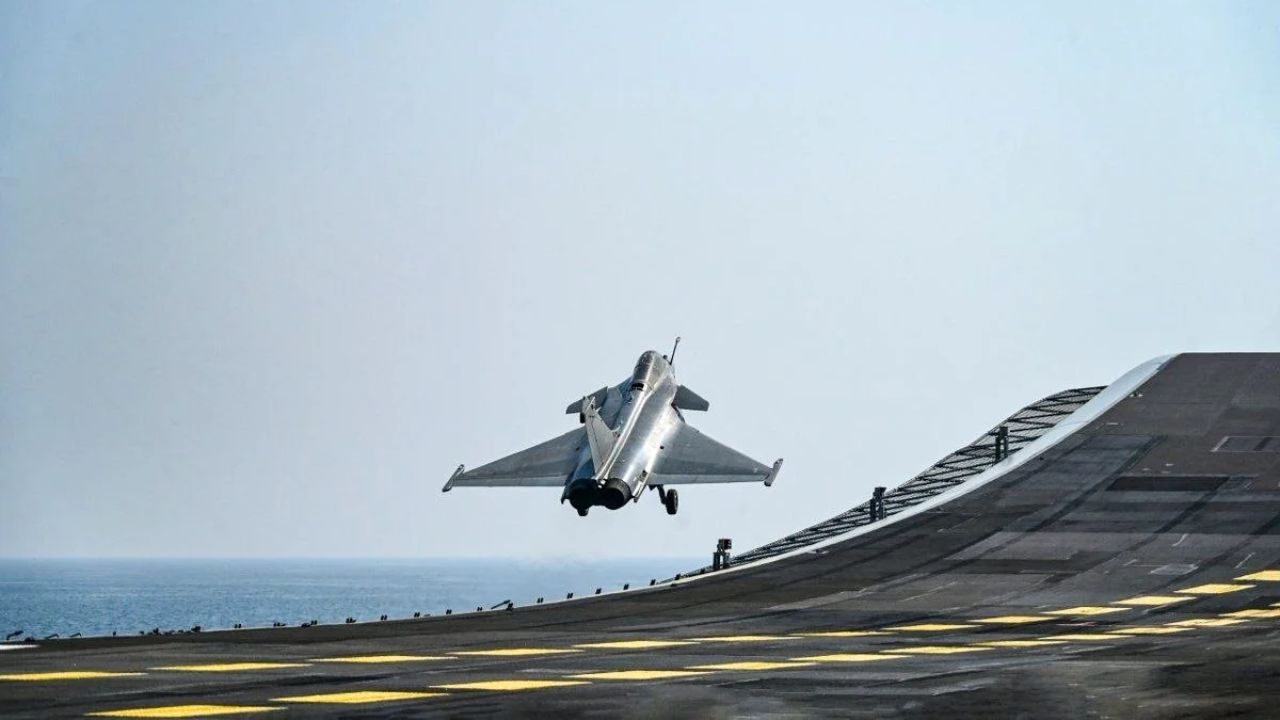
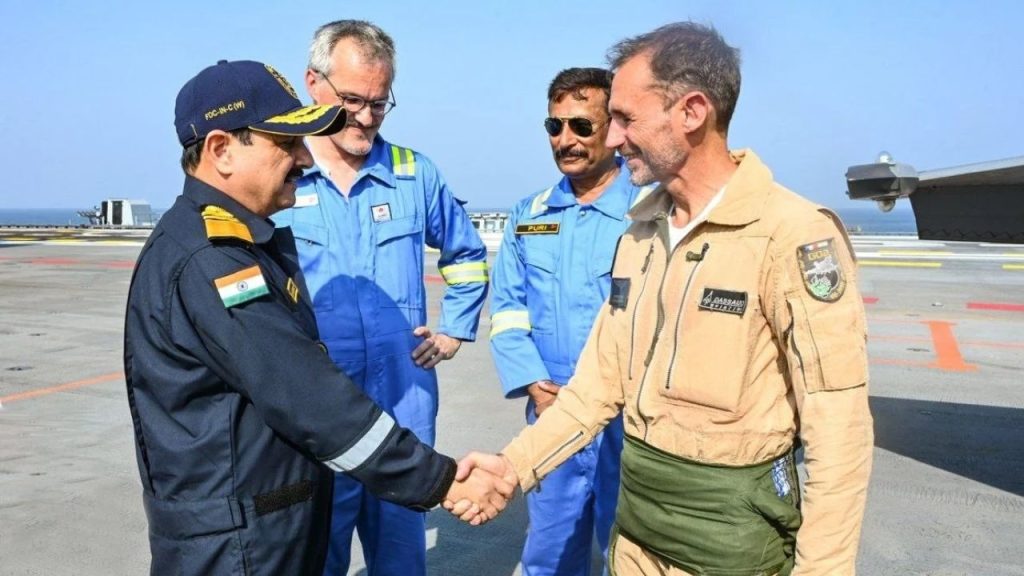
On 29 October, 2026, the Indian Navy achieved a milestone in strengthening its carrier-based air power with a Rafale Marine or Rafale M landing on INS Vikrant successfully in its maiden attempt. The Navy announced the achievement the next day as it looks forward to operationalising the aircraft.
Today, we build on what happened in the Rafale M landing on INS Vikrant, why it is significant and much more.
What Is the Rafale M?
Before we build on what makes the Rafale M landing on INS Vikrant so significant, let us learn about the aircraft and what makes it different from the usual variant.
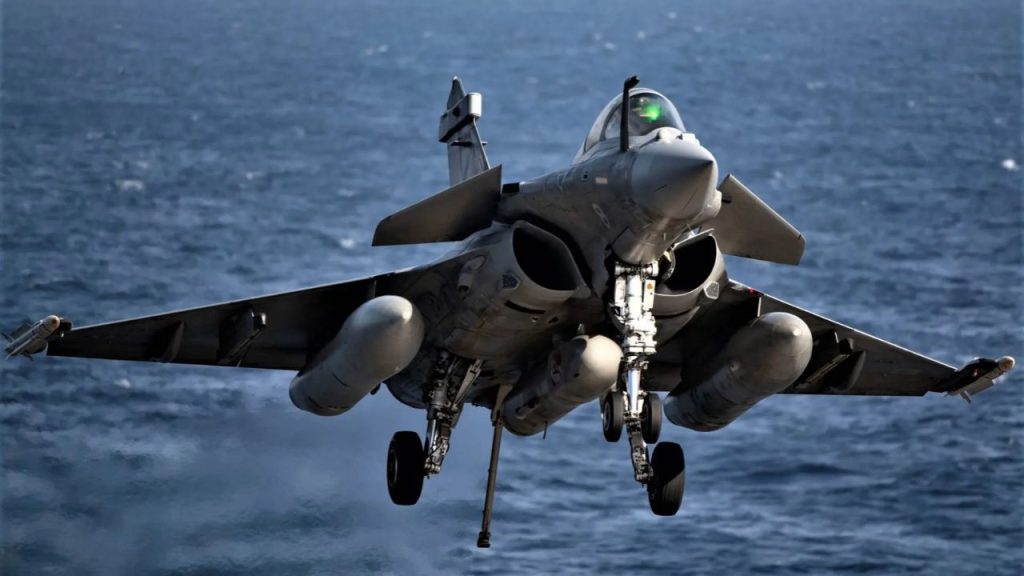
The Rafale M is Dassault Aviation’s carrier-capable naval version of its twin-engine multirole fighter aircraft, Rafale. The marine variant has specific features that are required for deck operations. These include reinforced landing gear and an arrestor hook.
Beyond its landing capabilities, it can also undertake fleet air defence, maritime strike, reconnaissance and attacks against targets ashore. It incorporates systems like the RBE2 AESA radar and SPECTRA electronic warfare suite. Similarly, its weapons options include Meteor and MICA air-to-air missiles, SCALP-EG and the AM39 Exocet anti-ship missile.
In short, this is an essential and capable aircraft, which is why the Rafale M landing on INS Vikrant occupies so much significance.
India’s Rafale M Deal
But, did you know that the Rafale M landing on INS Vikrant did not happen just like that? It required a lot of technicalities, including a formal deal and waiting time for its acquisition.
India and France signed an Inter-Governmental Agreement on 28 April 2025 for 26 Rafale aircraft for the Navy. As per official sources, this deal was worth approximately ₹63,000 crore.
The package includes 22 single-seat and four twin-seat aircraft, along with weapons, simulators, training, associated equipment and performance-based logistics support. The delivery is scheduled to be completed by 2030.
Apart from the acquisition of the Rafale M, the agreement also includes technology transfer for integrating indigenous weapons as well as plans for facilities in India to manufacture Rafale fuselage sections and maintain aircraft engines, sensors and weapons.
Significance of Rafale M Landing
Operating a fighter aircraft from a naval carrier is more demanding than from a land airbase. This is because it must launch from a short deck, land precisely on a moving ship and catch arresting wires with its tail hook. Hence, safe operation depends on a coordinated interplay of all the elements.
Interestingly, the Rafale M landing on INS Vikrant becomes way more important due to an inherent challenge as well. The aircraft was developed for the French Navy, keeping its requirements in mind. However, INS Vikrant uses a different launch system from France’s aircraft carrier Charles de Gaulle, which is as follows:
| Charles de Gaulle | INS Vikrant |
| It uses CATOBAR, that is, Catapult-Assisted Take-off But Arrested Recovery. Here, a catapult is used to launch the aircraft. | It follow STOBAR, that is, Short Take-off But Arrested Recovery. Here, it uses a ski-jump ramp to take off and later arrest its wires while landing. |
This is why the successful landing marks a stepping stone in India’s naval capabilities.

INS Vikrant
INS Vikrant was commissioned on 2 September 2022 and is India’s first indigenously-designed and built aircraft carrier. It was designed by the Indian Navy’s Warship Design Bureau and constructed by Cochin Shipyard Limited. This gigantic carrier displaces around 45,000 tonnes and can operate an air wing of up to 30 aircraft.
This is why the Rafale M’s maiden landing happened on it. Integrating the Rafale M would add a modern multirole fighter to its air wing, strengthen India’s fleet defence and maritime strike capabilities and our ability to sustain air power over important sea lanes.
Final Thoughts
The Rafale M landing on INS Vikrant in its maiden attempt is a milestone, however, it is not the end of testing or proof that the aircraft has entered operational service. The Indian Navy will be conducting further trials and integration work for fully operationalising the same.
Still, this milestone brings a modern carrier-borne fighter closer to integration with India’s home-built carrier, expanding our maritime reach and combat power at sea.