

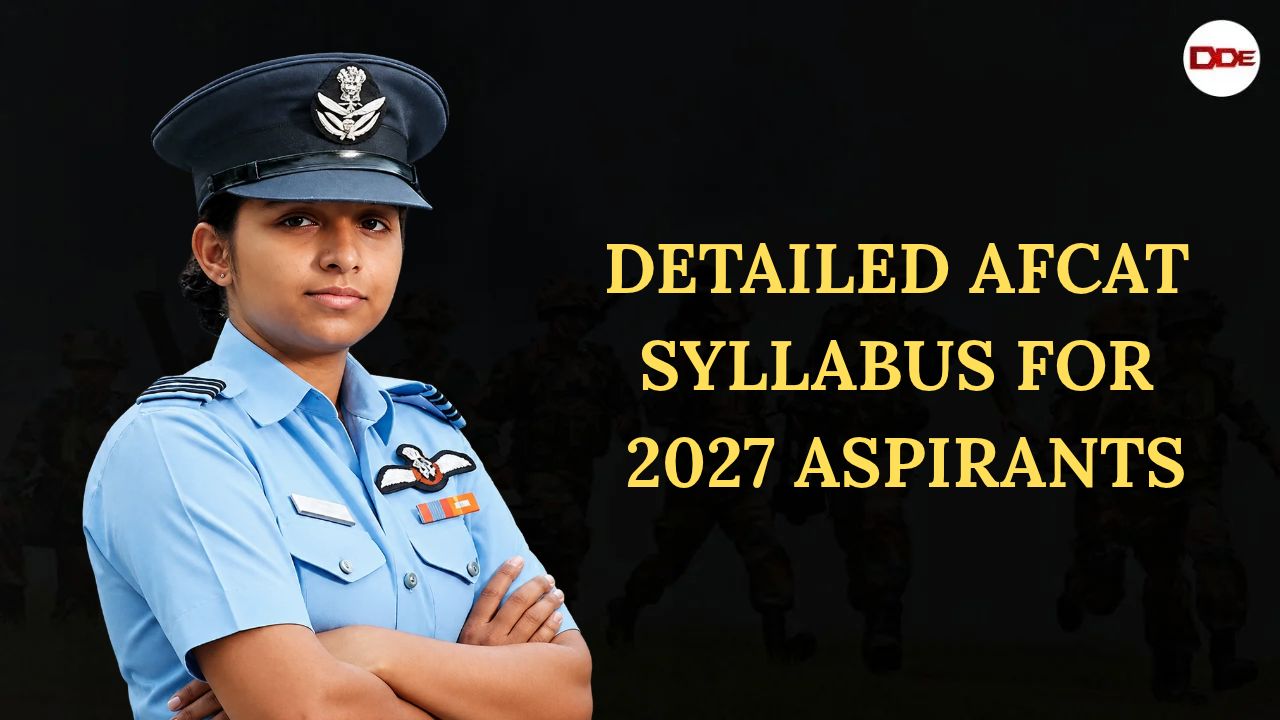
Do you aspire to sit for the Air Force Common Admission Test (AFCAT) 2027 and become an Indian Air Force officer? If your answer is in the positive, the first thing that you would need is the detailed AFCAT syllabus and exam pattern.
The examination tests candidates across four major areas. Hence, today, we tell you what the detailed AFCAT syllabus 2027 is, so that you’re ahead in your preparation.
AFCAT Exam Pattern
Before we tell you about the detailed AFCAT syllabus, it is essential for you to understand the structure of the examination. This will help you strategize your preparation and feel more confident. This is what the AFCAT exam 2027 pattern looks like:
| Mode of Examination | Online and computer-based |
| Total Number of Questions | 100 |
| Maximum Marks | 300 |
| Duration | 2 hours |
| Marking Scheme | 3 marks for each correct answer, -1 for each wrong answer, and 0 for each unanswered one |
| Type of Questions Asked | Objective-type questions with multiple choices |
| Language | English |
Generally, the numerical distribution of questions across individual subjects is as follows:
- 30 questions from English
- 25 questions from General Awareness
- 25 questions from Numerical Ability
- 20 questions from Reasoning and Military Aptitude
All those who qualify the written exam will be shortlisted for the AFSB interview.
Detailed AFCAT Syllabus For 2027 Aspirants
Now that we have shared the exam pattern for the Air Force Common Admission Test, we tell you the detailed AFCAT syllabus, if you are appearing for the examination in 2027.
Please note that the final syllabus will depend on the official notification released by the Indian Air Force, and this detailed AFCAT syllabus is based on the recent pattern of the same.

English
The most elaborate section in the detailed AFCAT syllabus is English which evaluates a candidate’s vocabulary, grammar, comprehension, and ability to understand written passages. This section comprises 30 questions (90 marks in total), hence, it is scoring and regular reading and practice are essential for improving both accuracy and speed.
The important topics included in the English section are as follows:
- Reading comprehension
- Error detection in sentences
- Sentence completion and fill in the blanks
- Synonyms and antonyms
- Cloze test
- Idioms and phrases
- Analogy
- Sentence rearrangement
- One-word substitution
- Substitution in a sentence
Tip: To score well, candidates must focus on grammar rules, vocabulary building, and solving timed practice questions at home. Moreover, practising comprehension passages can also help improve overall language proficiency.
General Awareness
Next we come to General Awareness, which covers static general knowledge as well as current affairs. This section comprises 25 questions (75 marks in total) and requires consistent preparation because its topics span a wide range of subjects.
The detailed AFCAT syllabus for this section majorly includes the given topics:
| Subject | Topics Asked |
| History | Important historical events, personalities, and developments in India and the world |
| Indian Polity and Economy | Constitutional basics, governance, economic concepts, and major developments |
| Science and Technology | Basic scientific knowledge, technological developments, and important discoveries |
| Defence | Indian defence forces, military exercises, equipment, and significant defence developments |
| Miscellaneous | Sports, awards, important personalities, national and international organisations, art and culture, environment and ecology, and current affairs |
Please note that the AFCAT exam is not as detailed as the Combined Defence Services Examination. Hence, if you have prepared General Awareness for the latter, it will help you in the former too. You can check the detailed CDS syllabus here.
Tip: Combine static general knowledge with regular current affairs revision. Candidates must also give particular attention to major national and international events, especially developments relevant to defence.
Numerical Ability
Numerical Ability tests mathematical understanding and problem-solving skills of candidates. This is elementary-level Mathematics and comprises 25 questions or 75 marks in total.
The important topics included in this section as per the detailed AFCAT syllabus are as follows:
- Number systems and number series
- Decimal fractions
- HCF and LCM
- Squares, square roots, cubes and cube roots
- Average and percentage
- Ratio and proportion
- Profit and loss
- Simple and compound interest
- Time and work
- Time, distance and speed involving trains, boats, and streams
- Mixture and allegation
- Area and perimeter
- Elementary mensuration
- Probability
- Clocks
- Statistics
- Exponents and powers
Tip: Candidates should strengthen their basics, memorise essential formulae, and practise calculations regularly. Since the examination has negative marking, solving questions accurately is just as important as solving them quickly.
Reasoning and Military Aptitude
Lastly, we have the reasoning and military aptitude section in the detailed AFCAT syllabus. This section assesses logical thinking, observation, analytical ability, and the capacity to identify patterns. It includes both verbal and non-verbal reasoning.
Candidates should prepare the following topics to excel in this section:
- Analogies
- Classification
- Coding-decoding
- Series
- Spatial reasoning
- Blood relation
- Figure-based questions (Paper folding and cutting)
- Dice-related questions
Tip: Regular timed practice can improve recognition speed and decision-making accuracy. Here, practice is the only thing that will prepare you.
Final Thoughts
The given detailed AFCAT syllabus provides candidates a framework for preparing for AFCAT examination. Remember that a strong command of English, consistent General Awareness preparation, sound mathematical basics and regular reasoning practice can help you prepare and attempt the test well. Good luck!