

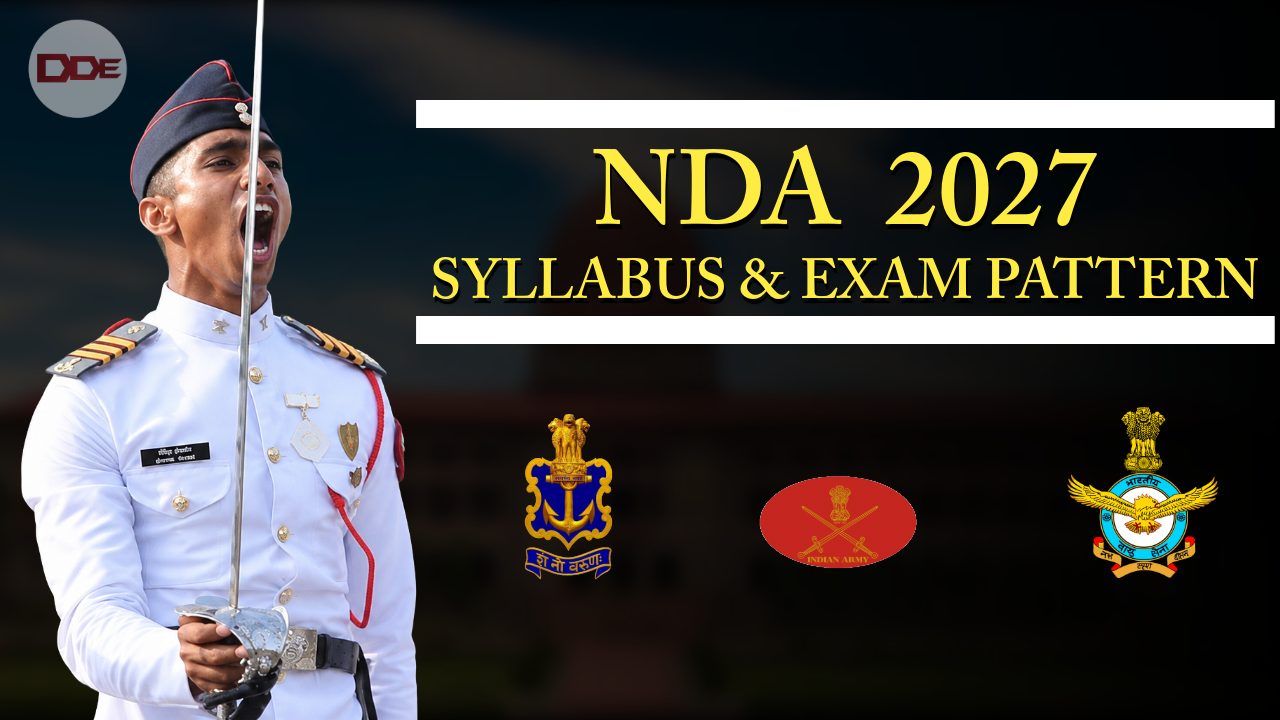
The National Defence Academy (NDA) examination is conducted by the UPSC twice each year and offers an opportunity for eligible candidates to join the Indian Army, Indian Navy and Indian Air Force as commissioned officers after training. Understanding the NDA exam syllabus is the first step towards building a robust preparation strategy for it.
Today, we build on the entire NDA exam syllabus for you, which will help you prepare and crack the exam.
UPSC NDA Exam Pattern
Let us understand the exam pattern before we elaborate on the NDA exam syllabus. Interestingly, the NDA written examination consists of two objective-type papers, carrying a combined total of 900 marks. Candidates who qualify the written examination are shortlisted for the SSB interview, which carries another 900 marks.
| Paper | Maximum Marks | Duration |
|---|---|---|
| Mathematics | 300 | 2.5 hours |
| General Ability Test (GAT) | 600 | 2.5 hours |
The examination follows negative marking for incorrect answers. Mathematics and the General Knowledge section of GAT are available in Hindi and English, while the English section tests English-language proficiency. Candidates should consult the latest official NDA notification for other exam-specific rules.

NDA Exam Syllabus
Now, let us build on the detailed NDA exam syllabus that you should be thorough with. We have divided this into sections for your convenience.
Paper I: Mathematics
The Mathematics paper, as per the NDA exam syllabus, evaluates numerical ability, logical reasoning and problem-solving skills of a candidate. Its major topics include:
- Algebra: Sets, Venn diagrams, real and complex numbers, quadratic equations, arithmetic and geometric progressions, logarithms, permutations and combinations, binomial theorem and matrices.
- Matrices and Determinants: Matrix operations, determinants, adjoint and inverse of matrices, and solving linear equations.
- Trigonometry: Trigonometric ratios, identities, compound angles, multiple and sub-multiple angles, inverse trigonometric functions, heights and distances, and properties of triangles.
- Analytical Geometry: Straight lines, circles, conic sections, coordinates in two and three dimensions, and equations of planes.
- Differential Calculus: Functions, limits, continuity, derivatives, increasing and decreasing functions, maxima and minima.
- Integral Calculus and Differential Equations: Integration, definite integrals, applications of integration and basic differential equations.
- Vector Algebra: Vector operations, scalar and vector products, and applications in geometry and mechanics.
- Statistics and Probability: Mean, median, mode, variance, standard deviation, correlation, regression, probability, conditional probability and Bayes’ theorem.
Candidates should practise mathematical concepts regularly and solve previous years’ question papers to improve speed and accuracy.

Paper II: General Ability Test (GAT)
Next is the GAT paper, which carries 600 marks and is divided into English and General Knowledge. According to the NDA exam syllabus, candidates are questioned on the following:
Part A: English for 200 Marks
This section, as per the NDA exam syllabus, assesses a candidate’s command of English and ability to understand written content. Some of the important topics asked include:
- Grammar and usage
- Vocabulary, synonyms and antonyms
- Sentence arrangement and cohesion
- Error detection and sentence correction
- Comprehension passages
- Appropriate use of words and expressions
Candidates must indulge in regular reading, grammar practice and vocabulary revision to improve their performance and also focus on this section as it can boost marks quite well.
Part B: General Knowledge for 400 Marks
The General Knowledge section, under the NDA exam syllabus, covers six broad subjects. Each questions candidates on a range of topics or areas. These include:
- Physics: Physical properties of matter, motion, force, work, energy, heat, sound, light, electricity, magnetism and basic scientific instruments.
- Chemistry: Elements and compounds, atoms and molecules, chemical reactions, acids and bases, oxidation and reduction, carbon compounds, and everyday applications of chemistry.
- General Science: Human body systems, nutrition, diseases, plant and animal life, environmental science and elementary scientific principles.
- History and Social Studies: Indian history, the freedom struggle, the Constitution, political developments, democracy, the Panchayati Raj system, fundamental rights, the United Nations and major social and economic concepts.
- Geography: Earth and its structure, latitude and longitude, climate, weather, oceans, natural resources, agriculture, minerals, Indian geography and major world geographical features.

Apart from this, candidates are also asked questions from current events that have made the headline in the country and the world. Some areas that they must focus on include:
- Recent national and international developments
- Important appointments
- Awards
- Sports
- Defence exercises
- Scientific achievements
- Government initiatives or schemes
The NDA exam syllabus comprises a wide range of topics, hence, candidates should go beyond the school-level textbooks and revise current affairs through credible sources and previous examination papers.
Final Thoughts
The NDA exam syllabus demands balanced preparation across all subjects, that is, Mathematics, English and General Knowledge. Therefore, candidates must have knowledge of the prescribed syllabus, work on their basic concepts, practise through several mock tests and revise everyday. Remember that the exam is just one step of the selection, but indeed, a crucial one. All the best for NDA 1 2027.