

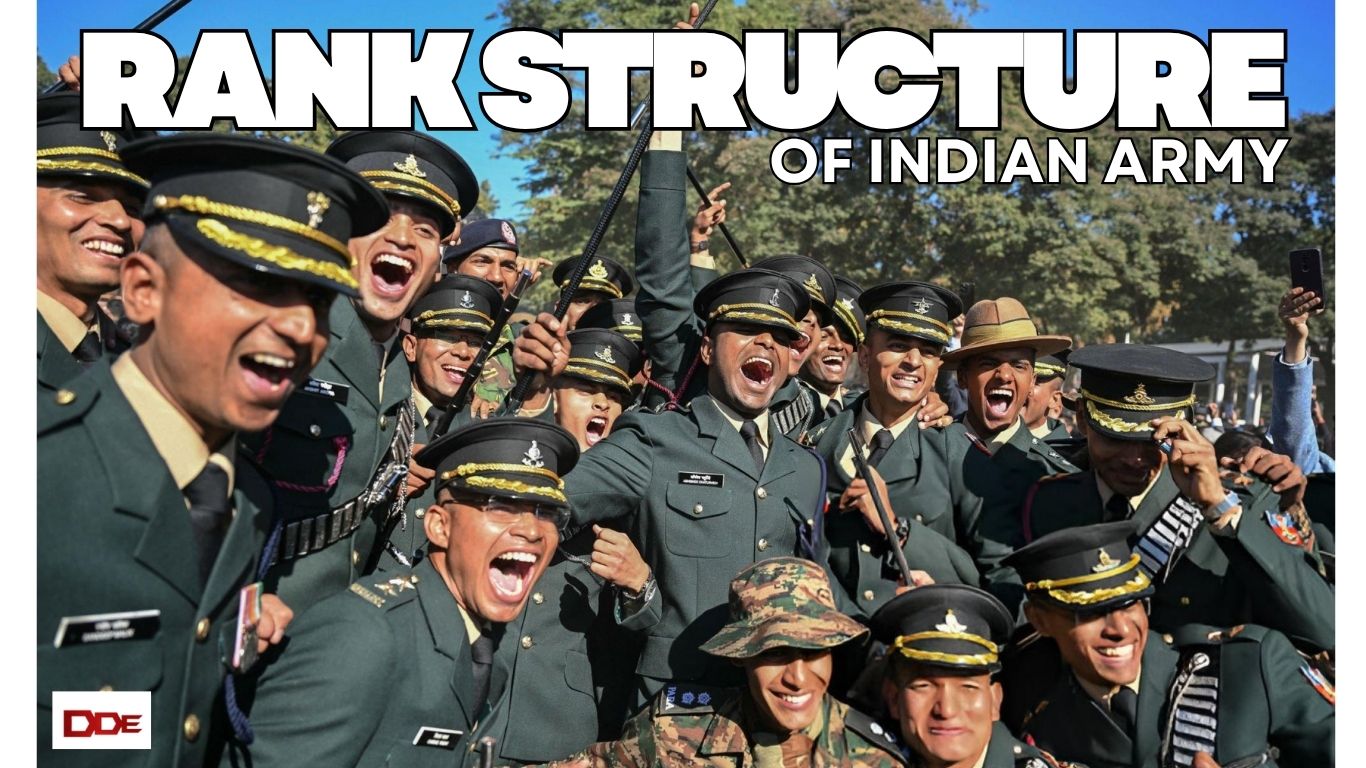
When you appear for the SSB interview, the interviewing officer (IO) takes keen interest in the Indian Army rank structure. This is especially true for freshers as it shows your seriousness towards the profession.
To avoid any confusion in front of him, we share a detailed rank structure with their equivalents in other services today.
Relevance of Indian Army Rank Structure in SSB
While interviewing you, the IO doesn’t just look for the 15 OLQs but also your knowledge about the service that you are applying for. One of the basic questions revolves around the Indian Army rank structure to check if you’re really serious for the career or you have simply come for leisure. He may grill you on it through questions such as:
- What is the first rank you’ll get after commissioning?
- What is the equivalent rank of Brigadier in the Indian Navy?
- What comes after IAF’s Wing Commander in Indian Army?
The nature of questions may change but the motive remains to understand your knowledge of the Indian Army rank structure.
Indian Army Rank Structure
Now that you know the relevance and ways in which your knowledge can be put to test, let us move forward. The Indian Army rank structure has three parts:
- Commissioned officers
- Junior commissioned officers
- Non-commissioned officers and other ranks
Commissioned Officers
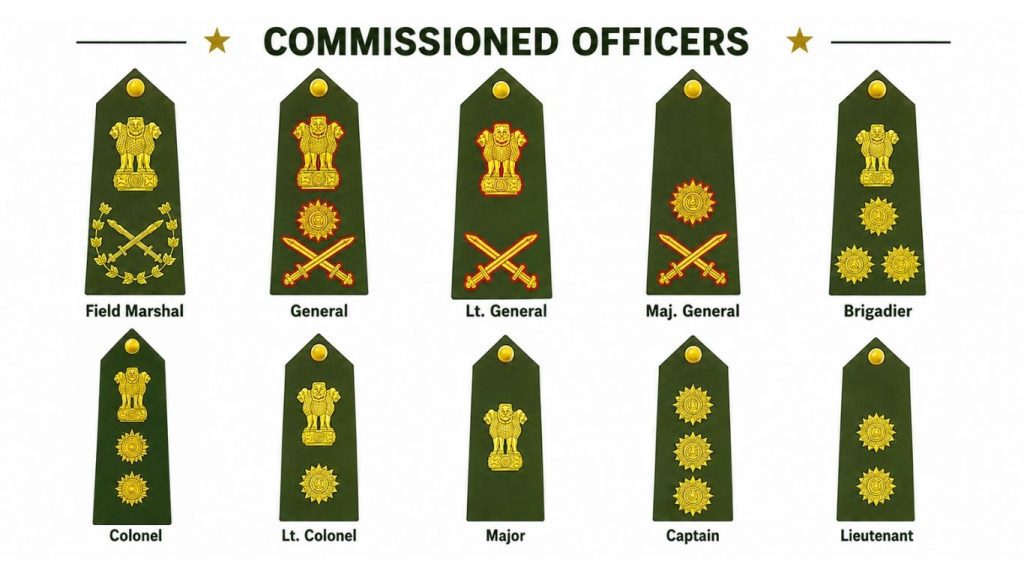
These are personnel who clear the SSB interview and constitute the officer ranks of the institution. Commissioned officers have the following hierarchy in the Indian Army rank structure, starting from the highest to the lowest:
Field Marshal
This is a ceremonial, five-star officer rank given to an officer as a recognition to his exceptional service, especially during wartime. A Field Marshal never retires officially. Till date, India has had two Field Marshals only, that is, Field Marshal SHFJ Manekshaw and Field Marshal KM Cariappa.
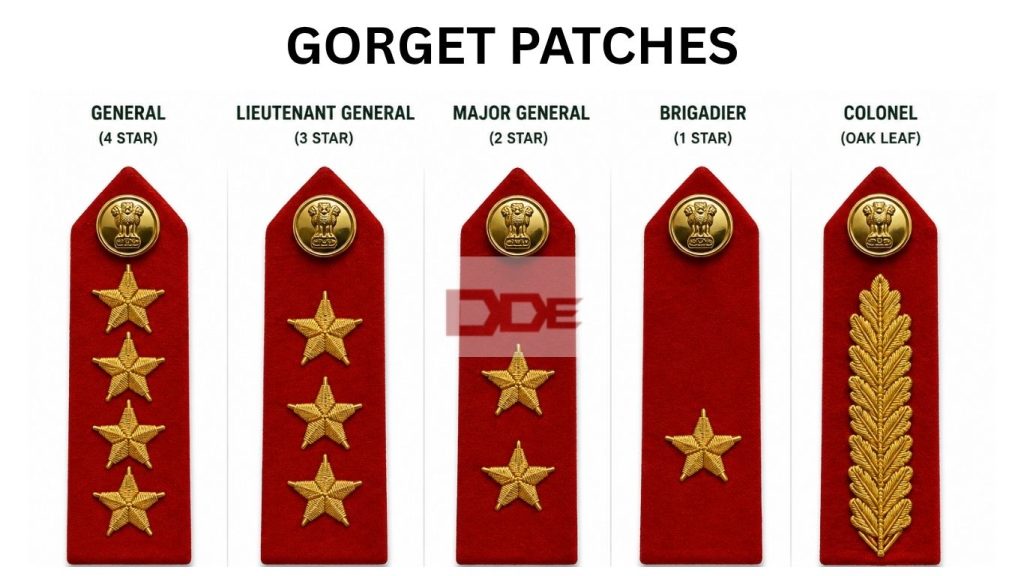
Insignia: The National Emblem above a crossed baton and saber within a lotus blossom wreath. He also wears a gorget patch on his collars, each bearing five stars.
General
This is a four-star officer rank given to the Chief of the Army Staff (CoAS), who is the professional head of the Indian Army. He oversees the Army HQs at New Delhi and the current CoAS is General Dhiraj Seth, PVSM, UYSM, AVSM.
Insignia: The National Emblem above a star, followed by a crossed baton and saber. He wears a gorget patch on his collars, each bearing four stars.
Lieutenant General
Next in the Indian Army rank structure is the Lieutenant General who is a three-star officer. He acts as the second-highest rank and takes up appointments such as the GoC-in-C of an Army command, the VCoAS or even the Corps Commander.
Insignia: The National Emblem above a crossed baton and saber with a gorget patch, each bearing three stars.
Major General
The Major General is a two-star officer who oversees a division in the Indian Army rank structure. He may also serve at key positions in the Army HQs being the third-highest rank holder.
Insignia: A star above a crossed baton and saber. He also wears the the gorget patch, each having two stars on his collars.
Brigadier
This is a one-star officer rank responsible for leading a brigade. A Brigadier is the fourth officer in the Indian Army rank structure and superannuates at 56 years of age.
Insignia: The National Emblem above three stars in triangular formation and a gorget patch on the collars, each bearing one star.
Colonel
A Colonel serves as the commanding officer (CO) of a battalion or regiment and leads all troops. He also oversees administrative roles in the Indian Army.
Insignia: The National Emblem above two stars. He also wears a gorget patch on both collars, each having an oak leaf.
Lieutenant Colonel
This is the next position in the Indian Army rank structure and a person can become a Lieutenant Colonel if they have served as a Major for some years and cleared the Part D exam. He commands a rifle company.
Insignia: The National Emblem above one star.
Major
To become a Major in the Indian Army, an officer must serve as a Captain for some years and clear Part B exam. This officer commands a platoon and oversees functions as the unit commander.
Insignia: The National Emblem.
Captain
This is the second position you will hold as per the Indian Army rank structure after commissioning. To become a Captain, you have to serve for at least two years as a Lieutenant. He commands a section.
Insignia: Three five-pointed stars.
Lieutenant
Lieutenants are also called young officers in the Indian Army rank structure as it is the first rank that cadets get after commissioning. You can become a Lieutenant through written entries like NDA and CDS or the SSB direct entries.
Insignia: Two five-pointed stars.
Junior Commissioned Officers
Now, we come to the JCOs. These are junior officers who are recruited through recruitment rallies and get promotions over the years. Despite being junior officers, they posses lots of experience and commissioned officers refer to them as ‘saab’ in the Indian Army.
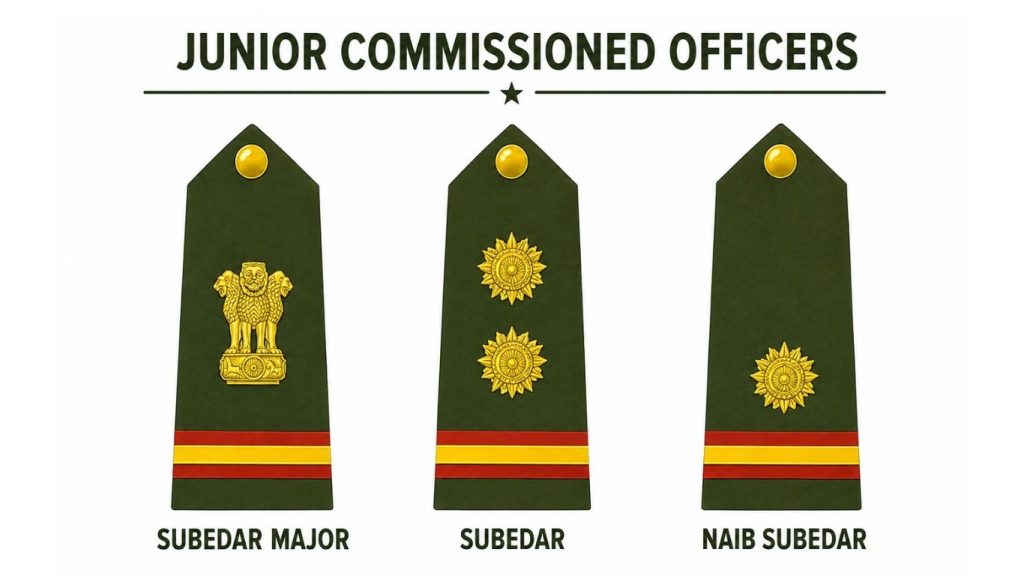
Subedar Major
This is the top-most rank of a JCO and is responsible for the discipline of the unit. A Subedar Major superannuates at the age of 54 years or after 34 years of service, whichever is earlier.
Insignia: The National Emblem above a stripe.
Subedar
This is the second JCO rank and reports to the Subedar Major directly. He may command a platoon or section (or assist commissioned officers in doing so).
Insignia: Two stars above a stripe.
Naib Subedar
Being the junior-most rank among JCOs, this officer looks into the administrative functions of the unit and ensures discipline of soldiers. He may retire after 28 years of service.
Insignia: One star above a stripe.
Non-Commissioned Officers and Other Ranks
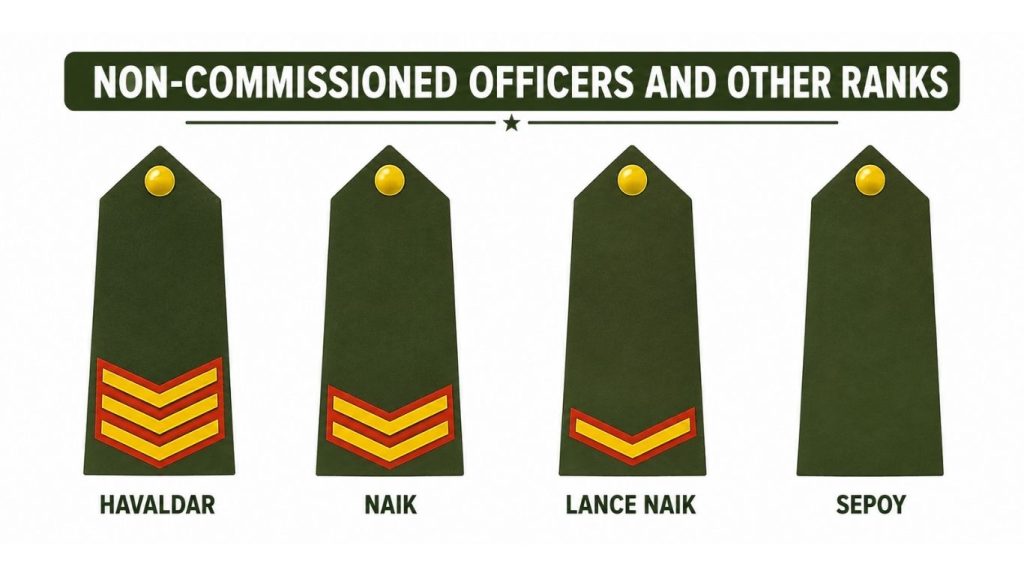
Lastly, we have the NCOs and ORs, who serve as the junior-most ranks in the Indian Army rank structure. They are often referred to as ‘jawans’ by officers and form the backbone of the Indian Army.
Havaldar
The rank of Havaldar is the highest NCO rank in the Indian Army. He assists JCOs and COs in leadership roles and may also command a section of soldiers.
Insignia: Three chevrons.
Naik
This is the second-highest rank of an NCO and leads smaller group of troops. A Naik retires after 23 years of service or 49 years of age, whichever is earlier.
Insignia: Two chevrons.
Lance Naik
A young recruit gets promotion and becomes a Lance Naik after about two years of service. His insignia includes one chevron.
Sepoy
These are young soldiers who appear for recruitment rallies under their respective AROs and become sepoys. They form the cornerstone of the Indian Army and have no insignia.
Final Thoughts
If you are appearing for your SSB interview, you must know about the Indian Army rank structure like the back of your hand. Remember that it tells the IO a lot about your seriousness for the career, therefore, you should never miss out on it.