

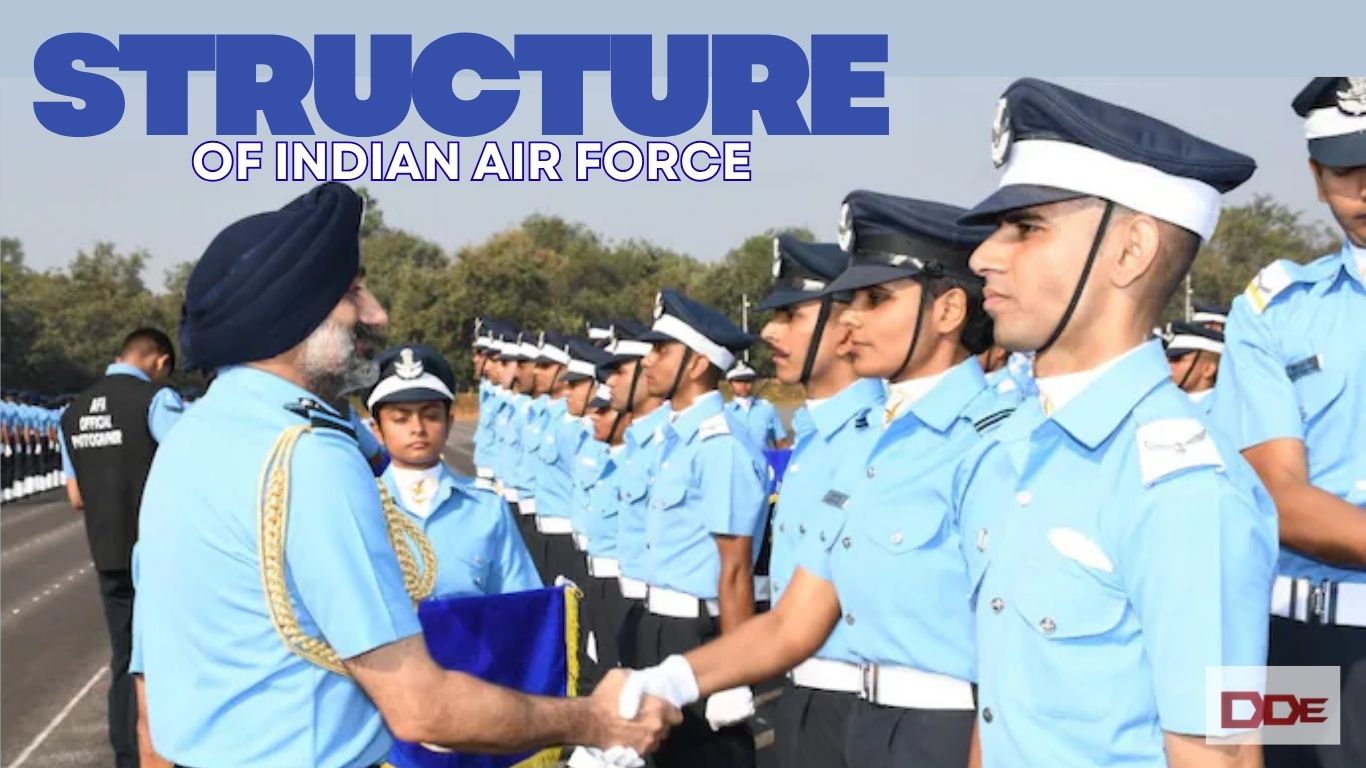
The IAF has overarching capabilities that make it one of the best air powers in the world. What keeps this institution running is its people who work through a hierarchy. This is the structure of Indian Air Force.
If you have an upcoming AFSB interview, you must prepare for this question in-depth and here’s how.
Need for Structure of Indian Air Force
You will agree that the IAF is a large organization, with specific roles and responsibilities for everyone. In the military, a hierarchy ensures accountability and the structure looks after this need. Some reasons why it exists are:
- Establishing points of contact for each level
- Rapid deployment with minimal loss of time
- Efficient management
- Defined roles and responsibilities
Clearly, the structure of Indian Air Force forms the foundation of its efficiency. Any AFSB candidate who does not know about it projects themself in negative light.
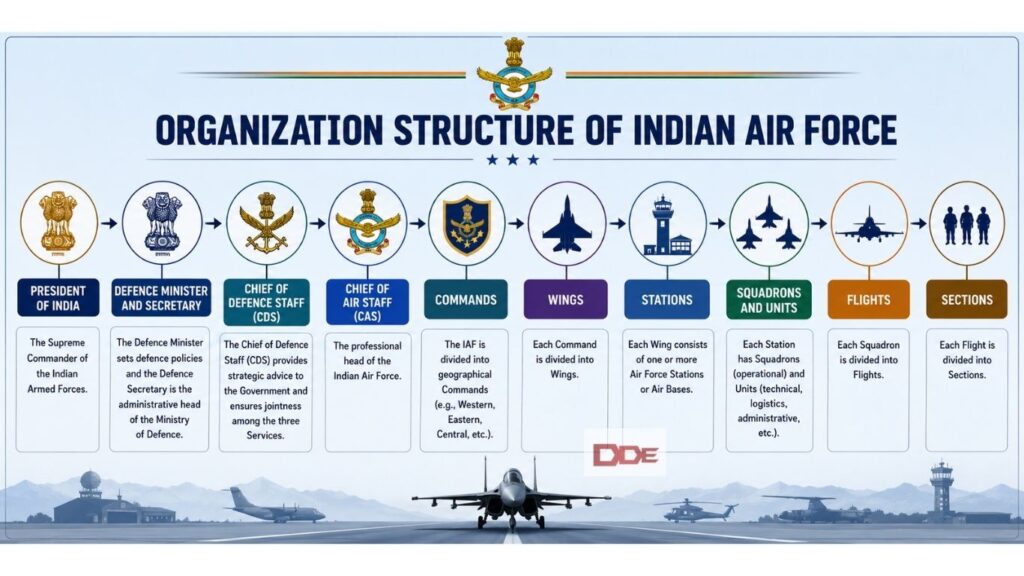
Structure of Indian Air Force
Let us look into the structure of IAF that is a favourite question of interviewing officers in AFSBs. Please know that the top three positions remain the same for the tri-services.
| POSITION | NAME OF POSITION HOLDER |
| President of India | Smt. Draupadi Murmu |
| Defence Minister and Secretary | Sh. Rajnath Singh and Sh. Rajesh Kumar Singh |
| Chief of Defence Staff (CDS) | General NS Raja Subramani, PVSM, AVSM, SM, VSM |
Chief of Air Staff (CAS)
After the CDS, the Chief of Air Staff leads the IAF as its professional head. The current CAS is Air Chief Marshal Amar Preet Singh, PVSM, AVSM. He heads the Air HQs at New Delhi.
Commands
Next, in the structure of Indian Air Force are the commands. The IAF comprises seven commands, two are functional whereas five are operational commands. Each command is led by an officer of Air Marshal rank, who is the Air Officer Commanding-in-Chief (AOC-in-C). Here is a table for your convenience:
| COMMAND | LOCATION | AOC-in-C |
| Eastern | Shillong, Meghalaya | Air Marshal Inderpal Singh Walia |
| Southern | Thiruvananthapuram, Kerala | Air Marshal Jasvir Singh Mann |
| South-Western | Gandhinagar, Gujarat | Air Marshal PV Shivanand |
| Western | New Delhi | Air Marshal George Thomas |
| Central | Prayagraj, Uttar Pradesh | Air Marshal Tarun Chaudhry |
| Training | Bengaluru, Karnataka | Air Marshal Seethepalli Shrinivas |
| Maintenance | Nagpur, Maharashtra | Air Marshal Yalla Umesh |
Wings
A wing comes under an Air Commodore and comprises 2-3 squadrons, helicopter units, as well as forward base support units. Its role is to ensure rapid deployment during war as fully operational air bases.
Stations
Stations are seventh in the structure of Indian Air Force. A Group Captain leads a station, which is a ground-based operational unit. It comprises about 1-2 squadrons and house IAF personnel, aircraft maintenance, et cetera. These are abbreviated as AFS.
Squadrons and Units
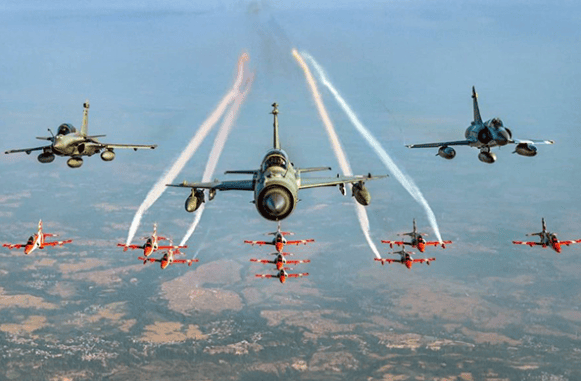
When it comes to the structure of Indian Air Force, a squadron is the unit which indulges in combat, surveillance, airlift, and other roles. An officer of Wing Commander rank heads a squadron. It has two parts:
- Fighter squadrons comprises about 18 aircraft and fly fighter aircraft.
- Transport and helicopter units
Flights
Flights are sub-divisions of squadrons and facilitate the latter’s tasks for better efficiency. A flight handles six aircraft (2 sections) and is led by a Squadron Leader.
Sections
The smallest unit in the structure of IAF is a section, which comprises only three aircraft. An officer of Flight Lieutenant rank heads the unit and ensures that roles such as reconnaissance are carried out smoothly.
This multi-tiered structure of Indian Air Force helps the organization in its everyday functions across IAF branches. It ensures coordination and every step and makes air warriors swift and efficient.