

Which chapters give the most questions in the Mathematics paper of the NDA exam? To find out, we went through the official UPSC question papers of the last five years and put every question under a topic. This post gives you the NDA Maths topic wise weightage from NDA 1 2022 to NDA 2 2026, with charts.
The count shows that the NDA Maths paper is led by Algebra, Statistics and Probability, and Differential Calculus. Probability alone gave about 12.7 questions in a paper. At the end, you will find the list of NDA Maths important topics for the next exam. The NDA 1 2027 Maths paper will be held on 11 April 2027, as given in our post on the NDA 1 2027 notification and exam date.
How We Did This NDA Maths Paper Analysis
- We took the 10 official Mathematics question papers, from NDA 1 2022 to NDA 2 2026, from the UPSC website.
- Each NDA Maths paper has 120 questions for 300 marks, to be solved in two hours and thirty minutes. All questions carry equal marks, so one question is worth 2.5 marks. One-third of the marks of a question is cut for a wrong answer. This is printed on the cover of every paper.
- We read each question and put it under one of 28 topics. The topics are grouped into eight parts, the same eight parts in which UPSC gives the NDA Mathematics syllabus: Algebra, Matrices and Determinants, Trigonometry, Analytical Geometry, Differential Calculus, Integral Calculus and Differential Equations, Vector Algebra, and Statistics and Probability.
- Many questions use two topics together. For example, a question on the maximum value of a trigonometric expression can be counted with trigonometry or with maxima and minima. We counted such a question only once, under its main idea. So please read all numbers as approximate.
- The papers are scanned copies. In 14 of the 1200 questions the text could not be read clearly, so the count below covers 1186 questions.
- UPSC does not publish any topic wise weightage. This NDA Maths paper analysis is our own count from the official papers.
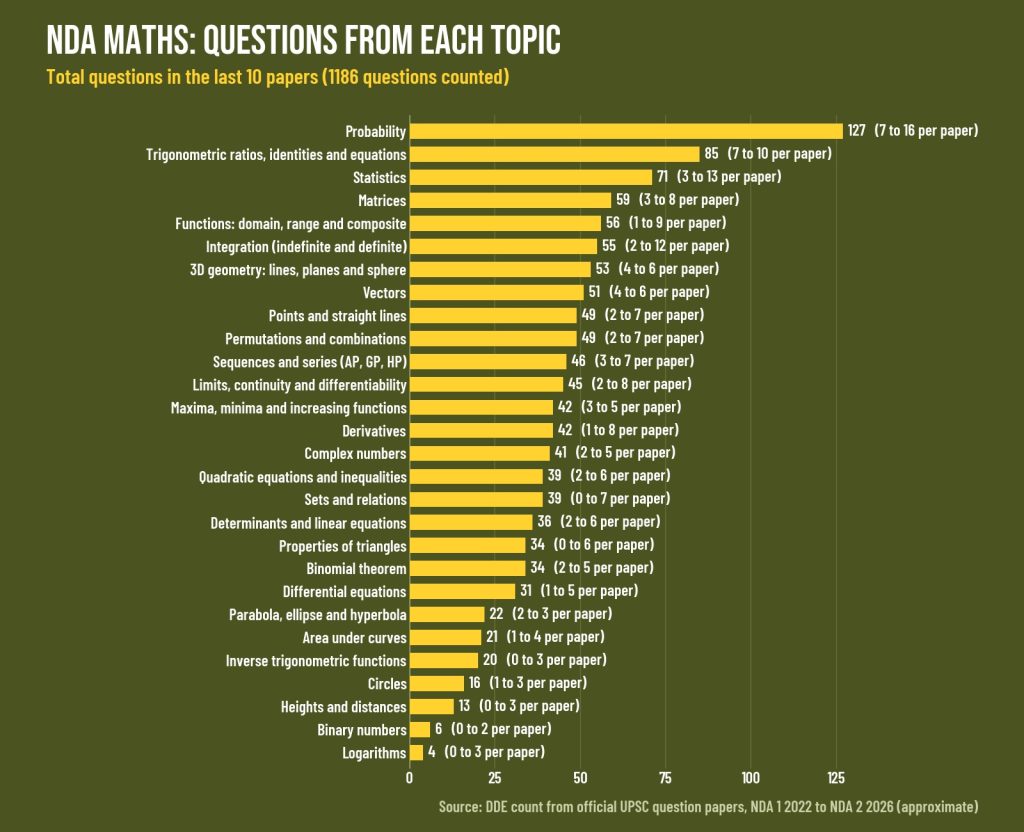
NDA Maths Topic Wise Weightage: Questions From Each Topic
Probability stands far above the rest with 127 questions in 10 papers. It is followed by trigonometric ratios, identities and equations (85), statistics (71) and matrices (59). In all, 22 of the 28 topics were asked in every one of the 10 papers.
| Topic | Part | Questions in 10 papers | Asked in | Lowest to highest in one paper | Average per paper |
|---|---|---|---|---|---|
| Probability | Statistics and Probability | 127 | 10 of 10 | 7 to 16 | 12.7 |
| Trigonometric ratios, identities and equations | Trigonometry | 85 | 10 of 10 | 7 to 10 | 8.5 |
| Statistics | Statistics and Probability | 71 | 10 of 10 | 3 to 13 | 7.1 |
| Matrices | Matrices and Determinants | 59 | 10 of 10 | 3 to 8 | 5.9 |
| Functions: domain, range and composite | Differential Calculus | 56 | 10 of 10 | 1 to 9 | 5.6 |
| Integration (indefinite and definite) | Integral Calculus and Differential Equations | 55 | 10 of 10 | 2 to 12 | 5.5 |
| 3D geometry: lines, planes and sphere | Analytical Geometry (2D and 3D) | 53 | 10 of 10 | 4 to 6 | 5.3 |
| Vectors | Vector Algebra | 51 | 10 of 10 | 4 to 6 | 5.1 |
| Permutations and combinations | Algebra | 49 | 10 of 10 | 2 to 7 | 4.9 |
| Points and straight lines | Analytical Geometry (2D and 3D) | 49 | 10 of 10 | 2 to 7 | 4.9 |
| Sequences and series (AP, GP, HP) | Algebra | 46 | 10 of 10 | 3 to 7 | 4.6 |
| Limits, continuity and differentiability | Differential Calculus | 45 | 10 of 10 | 2 to 8 | 4.5 |
| Derivatives | Differential Calculus | 42 | 10 of 10 | 1 to 8 | 4.2 |
| Maxima, minima and increasing functions | Differential Calculus | 42 | 10 of 10 | 3 to 5 | 4.2 |
| Complex numbers | Algebra | 41 | 10 of 10 | 2 to 5 | 4.1 |
| Sets and relations | Algebra | 39 | 8 of 10 | 0 to 7 | 3.9 |
| Quadratic equations and inequalities | Algebra | 39 | 10 of 10 | 2 to 6 | 3.9 |
| Determinants and linear equations | Matrices and Determinants | 36 | 10 of 10 | 2 to 6 | 3.6 |
| Binomial theorem | Algebra | 34 | 10 of 10 | 2 to 5 | 3.4 |
| Properties of triangles | Trigonometry | 34 | 9 of 10 | 0 to 6 | 3.4 |
| Differential equations | Integral Calculus and Differential Equations | 31 | 10 of 10 | 1 to 5 | 3.1 |
| Parabola, ellipse and hyperbola | Analytical Geometry (2D and 3D) | 22 | 10 of 10 | 2 to 3 | 2.2 |
| Area under curves | Integral Calculus and Differential Equations | 21 | 10 of 10 | 1 to 4 | 2.1 |
| Inverse trigonometric functions | Trigonometry | 20 | 9 of 10 | 0 to 3 | 2 |
| Circles | Analytical Geometry (2D and 3D) | 16 | 10 of 10 | 1 to 3 | 1.6 |
| Heights and distances | Trigonometry | 13 | 6 of 10 | 0 to 3 | 1.3 |
| Binary numbers | Algebra | 6 | 5 of 10 | 0 to 2 | 0.6 |
| Logarithms | Algebra | 4 | 2 of 10 | 0 to 3 | 0.4 |
NDA Maths Paper: Eight Parts In Each Of The 10 Papers
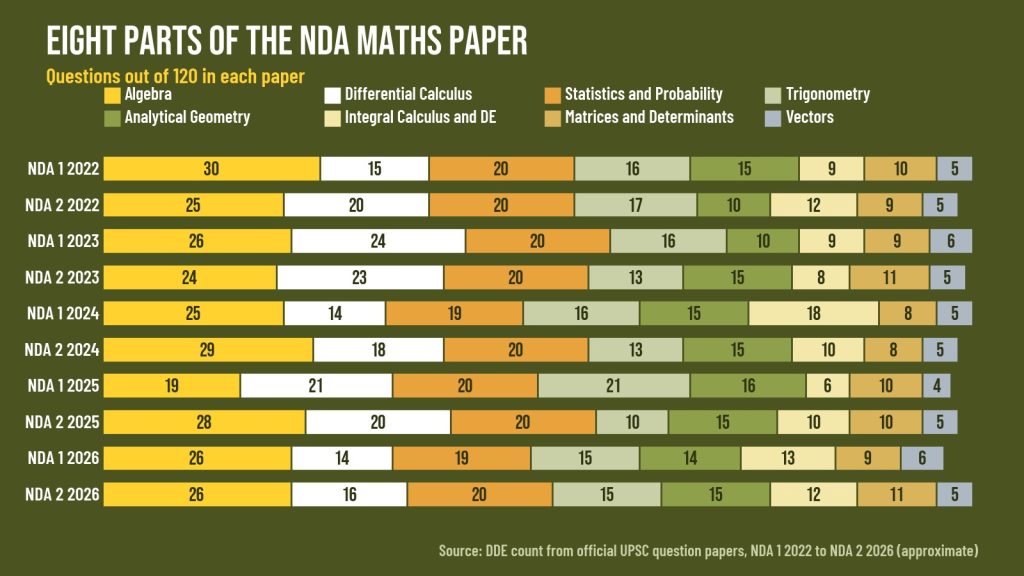
Here is the count for each of the 10 papers under the eight parts of the syllabus. Click on the exam name to open the official UPSC question paper.
| Exam | Algebra | Matrices and Determinants | Trigonometry | Analytical Geometry | Differential Calculus | Integral Calculus and DE | Vectors | Statistics and Probability | Not read |
|---|---|---|---|---|---|---|---|---|---|
| NDA 2 2026 | 26 | 11 | 15 | 15 | 16 | 12 | 5 | 20 | 0 |
| NDA 1 2026 | 26 | 9 | 15 | 14 | 14 | 13 | 6 | 19 | 4 |
| NDA 2 2025 | 28 | 10 | 10 | 15 | 20 | 10 | 5 | 20 | 2 |
| NDA 1 2025 | 19 | 10 | 21 | 16 | 21 | 6 | 4 | 20 | 3 |
| NDA 2 2024 | 29 | 8 | 13 | 15 | 18 | 10 | 5 | 20 | 2 |
| NDA 1 2024 | 25 | 8 | 16 | 15 | 14 | 18 | 5 | 19 | 0 |
| NDA 2 2023 | 24 | 11 | 13 | 15 | 23 | 8 | 5 | 20 | 1 |
| NDA 1 2023 | 26 | 9 | 16 | 10 | 24 | 9 | 6 | 20 | 0 |
| NDA 2 2022 | 25 | 9 | 17 | 10 | 20 | 12 | 5 | 20 | 2 |
| NDA 1 2022 | 30 | 10 | 16 | 15 | 15 | 9 | 5 | 20 | 0 |
- Statistics and Probability is the most fixed part. In every paper, almost all of the last 20 questions, from question 101 to 120, came from it. That is close to 50 marks out of 300.
- Algebra is the biggest part, with 19 to 30 questions and about 25.8 in a paper. It is spread over eight small topics, so no single chapter gives more than 7 questions.
- Differential Calculus gave 14 to 24 questions. With Integral Calculus and Differential Equations (6 to 18 questions), calculus is close to one-fourth of the paper.
- Trigonometry gave 10 to 21 questions and Analytical Geometry gave 10 to 16 questions.
- Matrices and Determinants gave 8 to 11 questions and Vector Algebra gave 4 to 6 questions. Both are small chapters with a steady return.
Which Topics Are Steady And Which Topics Jump
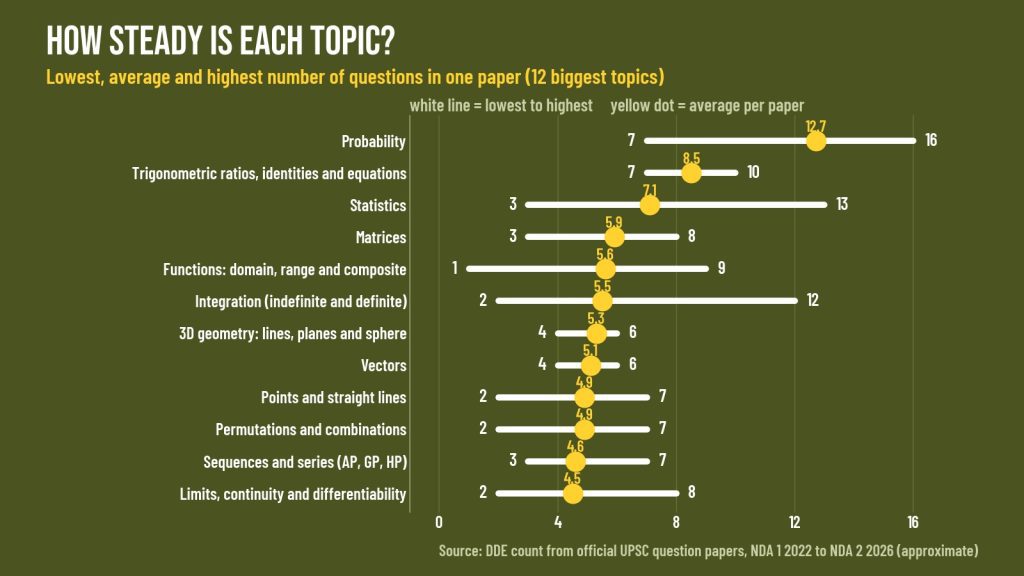
A topic with a high total is useful only if it comes every time. So this part of the NDA Maths paper analysis looks at the lowest and the highest number of questions from each topic in one paper.
Topics That Came In Every Paper
- Probability: never less than 7 questions and up to 16. The last five papers had 11 to 16 questions each.
- Trigonometric ratios, identities and equations: 7 to 10 questions in every paper. This is the steadiest big topic.
- 3D geometry and vectors: 3D geometry gave 4 to 6 questions and vectors gave 4 to 6 questions. The count hardly changes from paper to paper.
- Matrices and determinants: together they gave 8 to 11 questions.
- Maxima, minima and increasing functions: 3 to 5 questions in every paper.
- Parabola, ellipse and hyperbola: a small topic, but it gave 2 or 3 questions every single time.
Topics That Jump Or Come In Some Papers Only
- Statistics: mean, median, variance and regression gave 13 questions in one paper and only 3 in another. Inside the fixed block of 20, when probability goes up, statistics comes down.
- Sets and relations: 39 questions in all, but none in 2 of the 10 papers.
- Heights and distances: asked in 6 of the 10 papers, never more than 3 questions.
- Binary numbers and logarithms: binary numbers came in 5 papers and logarithms in 2 papers.
Two Question Styles To Practise
- Two or three questions on one piece of information: a function, a triangle or a set of data is given and two or three questions follow. All 10 papers had such sets. In NDA 1 2023, questions 31 to 90 were all in sets.
- Question with statements: two or three statements are given and you have to mark which of them are correct. One wrong statement costs you the full question, so the concept must be clear.
NDA Maths Topic Wise Weightage In The 2026 Papers
The two papers of 2026 are the latest guide for the next exam. This is how the 120 questions were divided in them.
| Topic | NDA 1 2026 | NDA 2 2026 |
|---|---|---|
| Probability | 16 | 16 |
| Trigonometric ratios, identities and equations | 9 | 7 |
| Matrices | 5 | 8 |
| Integration (indefinite and definite) | 6 | 6 |
| Sets and relations | 4 | 7 |
| Points and straight lines | 4 | 7 |
| 3D geometry: lines, planes and sphere | 6 | 5 |
| Vectors | 6 | 5 |
| Complex numbers | 5 | 5 |
| Sequences and series (AP, GP, HP) | 4 | 4 |
| Quadratic equations and inequalities | 3 | 5 |
| Limits, continuity and differentiability | 4 | 4 |
| Derivatives | 4 | 4 |
| Maxima, minima and increasing functions | 5 | 3 |
| Differential equations | 3 | 5 |
| Binomial theorem | 5 | 2 |
| Determinants and linear equations | 4 | 3 |
| Properties of triangles | 3 | 4 |
| Statistics | 3 | 4 |
| Permutations and combinations | 4 | 2 |
| Functions: domain, range and composite | 1 | 5 |
| Area under curves | 4 | 1 |
| Inverse trigonometric functions | 2 | 2 |
| Parabola, ellipse and hyperbola | 2 | 2 |
| Heights and distances | 1 | 2 |
| Circles | 2 | 1 |
| Binary numbers | 0 | 1 |
| Logarithms | 1 | 0 |
The NDA Maths topic wise weightage of the two 2026 papers is close to the five year average. Probability gave 16 questions in NDA 1 2026 and 16 in NDA 2 2026. So we expect the NDA 1 2027 Maths paper to stay close to this pattern.
NDA Maths Important Topics For NDA 1 2027 Maths Paper
Nobody can tell the exact questions before the exam. But going by the last 10 papers, these NDA Maths important topics have the highest chance of coming again in the NDA 1 2027 Maths paper. This is our reading of the trend and not an official list.
Highest Importance
- Probability: dice, coins, cards, conditional probability, independent events and binomial distribution. About 12.7 questions in a paper.
- Trigonometric ratios, identities and equations: values of angles, sum and product formulas, number of solutions. About 8.5 questions.
- Statistics: mean, median, mode, variance, standard deviation, correlation and regression. About 7.1 questions.
- Matrices and determinants: adjoint, inverse, properties of determinants and system of linear equations. About 9.5 questions together.
- 3D geometry and vectors: direction ratios, line, plane, sphere, dot product and cross product. About 10.4 questions together.
- Functions and integration: domain, range, composite functions and definite integrals. About 11.1 questions together.
Medium Importance
- Permutations and combinations, points and straight lines: about 4.9 questions each.
- Sequences and series, limits and continuity: about 4.6 questions each.
- Derivatives, maxima and minima: about 4.2 questions each.
- Complex numbers, quadratic equations, sets and relations: about 4.1 questions each.
- Binomial theorem, properties of triangles and differential equations: about 3 questions each.
Lowest Importance
- Conic sections, area under curves and inverse trigonometric functions: about 2 questions each.
- Circles, heights and distances: 1 or 2 questions each.
- Binary numbers and logarithms: at most 1 question in most papers.
Lowest importance does not mean leave it. These chapters are short, so finish them after the big topics are done.

How To Prepare For The NDA Maths Paper
Use this NDA Maths paper analysis to plan your study. The NDA Maths important topics listed above should get the first and the biggest share of your time. Here is a simple order to follow for the NDA Maths paper.
- Start with probability and statistics. They give about 20 questions in every paper and their formulas are few.
- Next, do trigonometry, matrices, determinants, vectors and 3D geometry. Their count is steady, so the time you give them is never wasted.
- Calculus is close to one-fourth of the paper. Build it in order: functions, limits, derivatives, maxima and minima, and then integration.
- Algebra has eight small topics. Take one topic at a time and solve a few questions every day.
- Solve the 10 official papers linked above with a timer of two and a half hours. You get about 75 seconds for a question. Start with the 2025 and 2026 papers.
- There is a penalty of one-third for every wrong answer, which is about 0.83 marks. Do not mark an answer by guess when you cannot remove at least two options.
How The Mission NDA Book Helps In Maths
Mission NDA by Defence Direct Education covers Mathematics, English and General Knowledge in one book of 1266 pages. In Mathematics, the questions are divided into three levels of difficulty, and the solutions are explained step by step.
Use the NDA Maths topic wise weightage given above to decide how much time each chapter of the book should get. Finish the NDA Maths important topics first and then move to the smaller ones. You can order the book from the banner given in this post.
For the full paper pattern, see our NDA 2027 syllabus and exam pattern. To fix your target marks, check the NDA cut off of the last 10 years. You can also practise our 30 important questions for NDA 1 2027 and read how to score well in NDA Mathematics.
Frequently Asked Questions
How many questions are there in the NDA Maths paper?
The NDA Maths paper has 120 questions for 300 marks, and the time allowed is two hours and thirty minutes. All 10 official papers from NDA 1 2022 to NDA 2 2026 had 120 questions each.
Is there negative marking in NDA Maths?
Yes. As printed on the question paper, one-third of the marks assigned to a question is deducted for every wrong answer. There is no penalty for a question left blank.
Which topic has the highest weightage in NDA Maths?
Over the last 10 papers, probability gave the most questions, 127 in all, followed by trigonometric ratios, identities and equations (85) and statistics (71). Part wise, Algebra is the biggest with about 25.8 questions in a paper.
How many questions come from statistics and probability in NDA Maths?
In all 10 papers, almost all of the last 20 questions (101 to 120) were from statistics and probability. Probability gave 7 to 16 of them and statistics gave most of the rest.
How many questions come from calculus in NDA Maths?
Differential Calculus gave 14 to 24 questions and Integral Calculus with Differential Equations gave 6 to 18 questions in the last 10 papers. Together they are close to one-fourth of the paper.
Does UPSC give the NDA Maths topic wise weightage?
No. UPSC does not publish any topic wise weightage. The numbers in this post are our own count from the official question papers, so they are approximate.